How would Picasso Paint in The Digital Age
Pablo Picasso, the titan of 20th-century art, reshaped the world with a single glance. His fractured forms, daring colors, and relentless reinvention—from Guernica’s anguished cry to the playful distortions of Les Demoiselles d’Avigno—made him a legend as towering as Vincent van Gogh. If Picasso were alive in 2025, would he cling to canvas and paint? Unlikely. A man who shattered tradition at every turn would surely seize a digital pen tablet, wielding tools like Procreate or Blender to push boundaries. Imagine him collaborating with Rosa Bergerac, a digital artist whose vibrant, textured works pulse with modern fire. Their styles—Picasso’s geometric audacity and Bergerac’s emotional, tactile depth—would clash and meld in a digital masterpiece. This 1600-word journey explores Picasso’s digital rebirth, compares his approach to Bergerac’s, and invites you to see her art as a living echo of his genius.
Picasso’s Legacy: A Shape-Shifter’s Soul
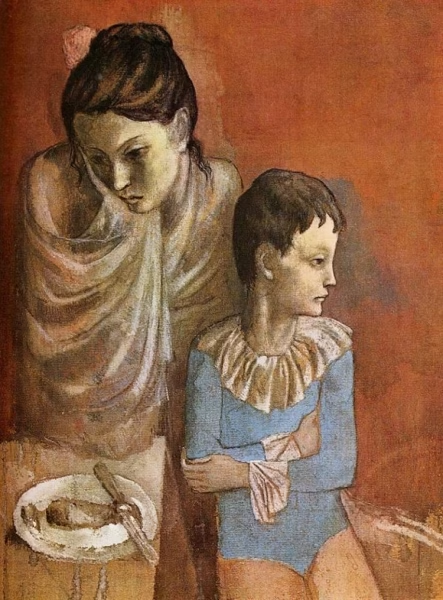
Pablo Picasso (1881–1973) was art’s great disruptor. He didn’t paint the world—he remade it. Born in Spain, he conquered Paris with a career spanning over seven decades, churning out 50,000 works. His Blue Period, like The Old Guitarist (1903), wept with melancholy; his Rose Period danced with circus whimsy. Cubism, co-invented with Georges Braque, fractured reality—Les Demoiselles d’Avignon (1907) shocked with its jagged faces, a middle finger to perspective. Later, Guernica (1937) screamed against war’s horrors, its monochrome chaos a global icon. Picasso was restless, leaping from surrealism to classicism, ceramics to collage, always chasing the new.
This hunger for reinvention makes Picasso a natural for digital art. He’d see a tablet—say, a Wacom Cintiq or iPad Pro—as a playground, not a cage. Apps like Procreate, Adobe Fresco, or Blender would let him distort, layer, and animate with the same ferocity he brought to canvas. And who better to “meet” him in this space than Rosa Bergerac? Her digital paintings, bold and textured, feel like emotions given form—kin to Picasso’s ability to make a line carry joy or dread. A collaboration between them would be electric, their styles weaving a tapestry of past and present.
Why Picasso Would Go Digital
Picasso thrived on breaking rules. He sliced faces into Cubist puzzles, glued newspaper to paintings, and sculpted with junk. Digital art, with its infinite possibilities, would be his siren call. Here’s why, with nods to how Bergerac’s work aligns:
- Endless Experimentation: Digital tools offer brushes, filters, and 3D modeling. Picasso could twist Girl Before a Mirror’s curves in seconds, much as Bergerac shifts textures to evoke mood.
- No Limits: No canvas size or paint budget—Picasso could scale Guernica to a skyscraper or shrink it to a phone, a flexibility Bergerac uses in her dynamic compositions.
- Speed and Iteration: He’d rework Three Musicians’ shapes instantly, layering without fear, like Bergerac’s layered, iterative process.
- Global Stage: Instagram or ArtStation would blast his art worldwide, as Bergerac does, her vivid posts drawing thousands.
Digital art would also ease Picasso’s life. He juggled studios and supplies; a tablet travels light, letting him sketch Dove of Peace on a train. The cost—pigments drained his early years—vanishes with software, freeing him to create endlessly, much like Bergerac’s prolific digital output.
Picasso’s Digital Process
Imagine Picasso in 2025, stylus in hand, tablet glowing. He’d dive into Procreate, sketching with the same urgency that birthed The Weeping Woman. His process, bold and chaotic, would mesh with digital tools, creating art that’s unmistakably his yet futurized. Here’s how:
1. Fractured Sketches

Picasso’s sketches were raw, exploratory. He’d start Les Demoiselles digitally, drawing jagged figures with a stylus, tilting faces at odd angles. Pressure sensitivity would let him vary lines—thick for bodies, thin for eyes—like Bergerac’s confident, varied strokes that build depth.
2. Cubist Layers
Cubism thrived on fragmentation. In Procreate, Picasso would layer Three Musicians, shifting squares and triangles without repainting. Bergerac uses layers too, stacking colors to make her work feel alive, though her forms flow where Picasso’s break.
3. Bold Palettes
His colors—blues of despair, pinks of joy—popped. Digitally, he’d sample millions of hues, tweaking Girl with a Mandolin’s greens mid-stroke. Bergerac’s palettes are bolder, almost neon, but both use color to stab at emotion.
4. Animation and Motion
Picasso loved movement—think Dance’s twirling figures. He’d animate Guernica’s horse, making it writhe subtly in After Effects, a nod to Bergerac’s dynamic compositions that hint at life beyond the frame.
5. 3D and AR Experiments
Ever the sculptor, Picasso would model Bull’s Head in Blender, twisting digital wire into horns. AR apps could project Guernica onto streets, immersive like Bergerac’s textured works that seem to leap off screens.
Comparing Styles: Picasso vs. Bergerac
While Picasso and Bergerac share a fire, their styles diverge and dance:
- Form: Picasso fractures—his Cubist faces like Dora Maar are puzzles, sharp and geometric. Bergerac flows, her forms softer, textured, almost liquid, evoking Van Gogh’s swirls more than Picasso’s edges. Yet both distort reality to reveal truth.
- Color: Picasso’s hues shift with mood—somber blues, fiery reds. Bergerac’s are vivid, often neon, with a modern pop-art vibe, but both wield color as emotion, not decoration.
- Texture: Picasso’s paint was thick, sculptural; digitally, he’d mimic that impasto. Bergerac’s digital textures feel tactile, layered to suggest depth, bridging Picasso’s physicality with virtual finesse.
- Intent: Picasso probed human conflict—war, love, identity. Bergerac leans personal, her art a diary of joy or chaos, but both make you feel before you think.
A collaboration would balance these. Picasso’s sharp angles might anchor Bergerac’s fluidity; her neon glow could soften his stark lines. Together, they’d create something neither could alone—structured yet free, raw yet radiant.
A Digital Masterpiece: Fractured Fields
Let’s imagine their project: Fractured Fields, a digital installation blending Picasso’s Cubism with Bergerac’s emotional depth. Picture a VR gallery where you step into a field—not Van Gogh’s wheat, but a Cubist dream. Stalks break into triangles, skies shatter into blue shards, yet Bergerac’s touch adds warmth—golden glows, pulsing textures. Stars, angular like Picasso’s Starry Night sketches, flicker to beats synced with your pulse, a nod to Bergerac’s immersive style.
In Procreate, Picasso sketches jagged cypresses, fracturing them into planes. Bergerac layers crimson streaks, softening edges with her fluid brushwork. They use Blender for 3D hills, textured with AI brushes via xAI’s API, blending Picasso’s stark forms with Bergerac’s tactile sheen. Unity powers the VR, letting you “touch” a stalk—it reforms into a face, Picasso’s nod to Weeping Woman, glowing with Bergerac’s neon. AR apps project the field onto city walls, stars scattering when passersby wave, a shared vision of art that moves.
Their process isn’t smooth. Picasso’s AI pushes hard angles, overwhelming Bergerac’s flow. She counters with softer blends, teaching balance. They argue via code—Picasso “suggests” a stark bull; Bergerac replies with a glowing bird. The tension births beauty, their styles fusing into a field that’s both fractured and whole, a mirror of 2025’s chaos and hope.
Themes: Chaos and Connection

Fractured Fields speaks to now. Picasso painted conflict—war in Guernica, love’s pain in Dora Maar. Bergerac paints the self—joy, doubt, resilience. Their work asks: in a world of fractured screens, what binds us? The field shifts with your mood, shards tightening if you’re tense, loosening if you’re calm. Touch a star, and it sparks a memory—Picasso’s angular faces or Bergerac’s glowing blooms—urging slowness in a rushed age. Climate flickers at the edges, fields browning unless you linger, a nod to shared futures. It’s art that demands feeling, not just seeing.
Impact and Legacy
Fractured Fields launches globally—VR in Tokyo, AR in New York. Fans share clips, #FracturedFields trending as stars dance on TikTok. Rosa posts timelapses, captioned, “Picasso taught me edges.” The AI “writes,” quoting Picasso: “Art washes away the dust of everyday life.” Museums host VR tours, schools use AR for lessons—kids reshape fields, learning creativity. Bergerac funnels proceeds to art therapy, honoring Picasso’s belief in art’s healing.
Bergerac’s Real Fire
This is fiction, but Rosa Bergerac’s art is real, burning with Picasso’s audacity. Her digital works—bold, textured, alive—fracture reality in their own way, colors popping like his, textures deep as her own heart. See it at Rosa Bergerac Art (placeholder—check her site or socials). Her gallery—a neon slash, a glowing face—feels like Picasso reborn.
The Soul of It
Picasso’s genius was reinvention; Bergerac’s is emotion. Digitally, they’d make Fractured Fields sing—sharp yet soft, chaotic yet warm. Stand in their VR field, stars pulsing. What hits you—the angles, the glow, the pull? That’s their art—then, now, always.
Further Digital Art Reading
Do you want to know how Vincent van Gogh would paint in the 2025 Digital Age. Read the imaginative story by Rosa Bergerac envisioning a digital collaboration with Vincent van Gogh going Digital Age.
Discover Rosa Bergerac’s art at Rosa Bergerac Art to feel Picasso’s legacy in every daring, digital stroke.
Love to you all my friends and stay safe, Rosa Bergerac ♥
Subscribe to our newsletter!