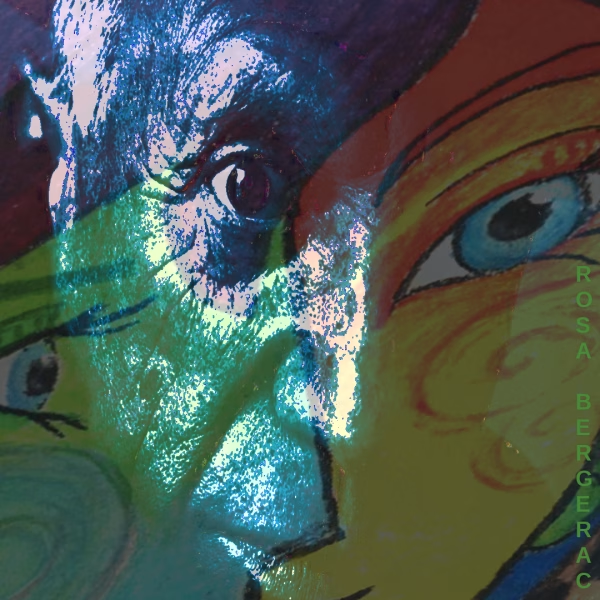
Pablo Picasso, as Rosa Bergerac experiences him
Bringing together all senses
Pablo Picasso was a Spanish painter, sculptor, printmaker, ceramicist, and stage designer who is widely recognized as one of the most influential artists of the 20th century.
Here are some interesting key points about him for who is interested:
Quotes from Pablo Picasso, Rosa Bergerac totally agrees with:
“Painting is a blind man’s profession. He paints not what he sees, but what he feels, what he tells himself about what he has seen” – Pablo Picasso.
“Different themes inevitably require different methods of expression. This does not imply either evolution or progress; it is a matter of following the idea one wants to express and the way in which one wants to express it.” – Pablo Picasso.
“Cubism is not a reality you can take in your hand. It’s more like a perfume, in front of you, behind you, to the sides, the scent is everywhere but you don’t quite know where it comes from.” – Pablo Picasso.
“I am always doing that which I cannot do, in order that I may learn how to do it.” – Pablo Picasso.
“The world today doesn’t make sense, so why should I paint pictures that do?” (1939-1945) – Pablo Picasso.
Pablo Picasso Life and Paintings
Pablo Ruiz Picasso (October 25, 1881 to April 8, 1973) was born in Malaga, Spain into a creative family. His father was a painter and young Picasso quickly showed artistic signs as well.
From an early age, his father taught him formal drawing techniques, culminating in a mastery of oil painting when he was just eight years old
His first known picture is called Le Picador (1890) which he produces when he is only 8 years old.
At the young age of thirteen, Picasso began his career as an artist. At this time, he worked in a “Realist style”; he depicted subjects authentically, and employed a true-to-life color palette. He particularly enjoyed painting scenes inspired by his Catholic faith and portraits of his family members.
This traditional, academic approach is evident in his church-inspired paintings and his portrayals of loved ones, like The Altarboy and Portrait of the Artist’s Mother.


Picasso’s father grooms the young boy to be a great artist by providing his son with the best artistic education the family can afford. The father and son visit Madrid to see works by Spanish Old Masters. And when the family moves to Barcelona, young Picasso continues his art education. He was admitted to the Barcelona School of Fine Arts at just 15. It is in Barcelona that Picasso first matures as a painter. Here in Barcelona, he is exposed to the “Avant-garde culture”, in which young artists are encouraged to express themselves. From 1897 Picasso’s paintings therefore take on a less lifelike quality. Undoubtedly influenced by Expressionist Edvard Munch and Post-Impressionist painter Toulouse-Lautrec, these pieces—like The Artist’s Sister Lola—convey Picasso’s growing interest in experimenting with the more free Avant-garde style.

When Picasso first travels to Paris, the European capital of art, he soaks up the art-world there, which is enlightening for Picasso and a huge influence for the rest of his artistic life. Over the decades, Picasso continually travels to and from, Spain, France and New York, soaking up the art world and developing himself as an artist.
Picasso’s styles change throughout his career. Although his work is usually characterized by a dominant approach, he often moves interchangeably between different styles – sometimes even within the same artwork. Art historians have categorized his paintings into distinctive periods, each period displaying a unique style and use of colors.
The Blue Period (1901-1904): A period in Picasso’s life characterized by somber paintings in shades of blue and blue-green, reflecting themes of poverty, loneliness, and despair. It was in this period that he starts sculpting as well. The most poignant of Picasso’s paintings in this period, was La Vie (1903), which he paints in memory of his childhood friend, the Spanish poet Carlos Casagemas, who commits suicide.
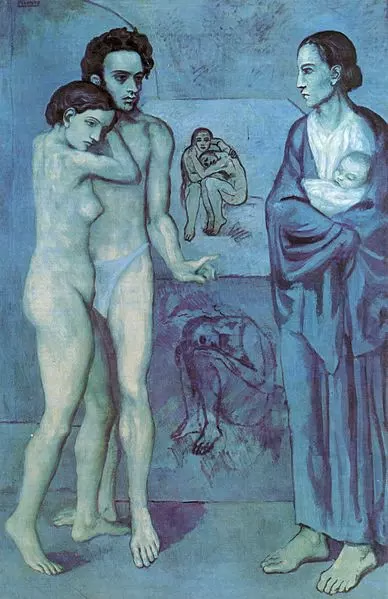
Other paintings are “The Old Guitarist” and “Mother and Child (1901).

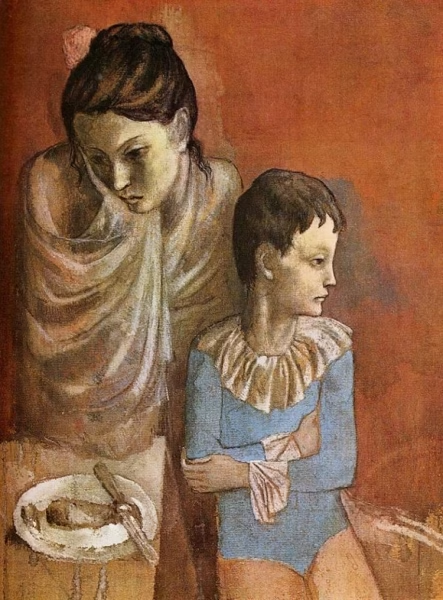
The Rose Period (fall 1904-end of 1906). The pictures of this period are marked by a shift to warmer colors like pink and orange.
As Picasso transitioned to his Rose Period in 1904, he continued to depict figures in his characteristically painterly style. While blue tones are still present in these paintings, they are contrasted by the warmer shades. After moving to Montmartre, a Bohemian district in Paris, he shifted his focus from individuals living in despair to entertainers, including harlequins, acrobats, and other circus performers. showing a more optimistic view as opposed to the paintings of the Blue Period.
Picasso’s ‘African Period’ or Black Period (1906 to 1909).
During the early 1900s, the aesthetics of traditional African sculpture became a powerful influence among European artists who formed an avant-garde in the development of modern art.
In France, Henri Matisse, Pablo Picasso, and their School of Paris friends blended the highly stylized treatment of the human figure in African sculptures with other painting styles. The building blocks that led to the construction of Picasso’s works during this period are diverse in nature.
In these years, African sculptures and traditional African masks strongly influence Picasso’s paintings, which led to some interesting and famous artworks, showing pictorial flatness, vivid color palette, and fragmented Cubist shapes. This helped to define early modernism.
Picasso instantly recognized the spiritual aspect and adapted these qualities to his own efforts to move beyond the naturalism that had defined Western art since the Renaissance.

The influences that characterize this transition period range from Post-Impressionism, to Symbolism, and Neo-Impressionism, the works of Edouard Manet, Paul Cezanne and Paul Gauguin to African art, the art of ancient Egypt in addition to non-African influences including Iberian sculpture.
Cubism Period, (1907 – 1912). Starting already around 1907 with “Les Demoiselles d’Avignon”. Picasso began to deconstruct objects into geometric shapes, abandoning perspective, leading to Analytical Cubism and later Synthetic Cubism, where he incorporated collage elements.
Picasso painted numerous portraits and still lifes during his Cubist phase.

After World War I, a strain of conservatism spreads throughout Europe – a motto popular among traditionalists was “the return to order.”
Classicism period (1920 to 1925). During these years, Picasso starts painting more classically and his paintings follow the more natural forms. He allows people to think that he abandoned cubism. However Picasso continues to evolve, exploring various styles like Neoclassicism in the 1920’s, and later, more abstract forms.
Portrait of Olga Khokhlova one of Picasso’s muses by Pablo Picasso

Surrealism Period (1925-1932). Following his classicism period, Picasso moves away from realism again. In 1925, he begins working in a surrealist manner. This style is characterized by figures with disorganized facial features and twisted bodies.
Picasso accentuates this “surreal” quality by using bright tones and clashing colors. He further confuses the viewer by skewing our sense of perspective and combining his subjects with organic and geometric forms.
Pablo Picasso produced Girl before a Mirror in 1932 as an oil on canvas painting. The picture depicts Picasso’s mistress and muse, Marie-Thérèse Walter, standing in front of a mirror, gazing at her reflection. During the 1930s, Picasso painted Marie-Thérèse, the mother of their daughter Maya Widmaier-Picasso, many times. His pictures of her from 1932 were the first public exhibition of their secret romance during his marriage to Olga Khokhlova.

Girl before a Mirror is a photograph of a lady gazing in a mirror, revealing a darker reflection of herself. The woman’s face has been split into two parts, one of which is painted in a peaceful, lilac color, and the other in a vibrant, yellow.
Picasso’s creative career was shaped by the year 1932. He had reached the age of 50 at this point in his life and had established himself as a significant artist.
The years leading up to World War II
This period had an immense influence on Picasso’s emotions and paintings.
A series of his paintings embodying that emotion is “The Weeping Woman” , a series of paintings by Pablo Picasso created in 1937, depicting his muse Dora Maar and symbolizing the suffering caused by the Spanish Civil War, particularly in response to the bombing of Guernica. The artwork is characterized by its emotional intensity and abstract style, using bold colors and angular shapes to convey grief.

One of his most famous works from that period is Guernica (1937)
Probably Picasso’s most famous work, “Guernica”in black and white, a powerful political statement, painted as an immediate reaction to the Nazi’s devastating bombing on the Basque town of Guernica during the Spanish Civil War.
It shows the tragedies of war and the suffering it inflicts upon individuals, particularly innocent civilians. This work has gained a monumental status, becoming a perpetual reminder of the tragedies of war, an anti-war symbol, and an embodiment of peace.

World War II (1939-1945)
Picasso, stayed in Paris during the German occupation of WW2. Some of Picasso’s paintings from this period show the anxiety of the war years.
Upon receiving news of the Nazi death camps, Picasso also painted, although he did not finish, a homage to the victims of the Holocaust (mass murder of European Jews during the war). In this painting, called “The Charnel House” (1945), he restricts the color scheme to black and white (as in Guernica) and depicts an accumulation of distorted, mangled bodies.
During the war in 1944 Picasso joins the Communist Party and his art often reflected his political views, especially during and after the Spanish Civil War. After the war he attends several peace conferences.

Later Works (1945-1973)
Picasso’s later period did not receive universal acclaim from art historians or critics. However in this period, Picasso continues to paint portraits and landscapes. Picasso also experiments with ceramics, creating figurines, plates, and jugs.

His Legacy for the 21st Century

Picasso’s impact on art is profound. He not only changed the course of art with Cubism but also through his constant innovation and refusal to be confined to one style.
His work has influenced countless artists across various mediums.
Picasso’s ability to reinvent himself and his art made him a figure of endless fascination and study. His works continue to be celebrated for their innovation, emotional depth, and the challenge they pose to traditional perspectives on art.
He passed away on April 8, 1973, in Mougins, France, but his legacy lives on in museums, galleries, and art history studies worldwide.
And in 2025, just as we become more and more aware of the complexity of our reality, Picasso’s confusing art aligns more and more to the reality of our modern world.
European Art Museums Showing Pablo Picasso Artworks
Museo Picasso Malaga – Since October 27, 2003, established by Picasso’s children.
Malaga being his birth city. A really compact museum showcasing a substantial number of Picasso’s works, spanning his 7 decade career.
Musee Picasso Paris – Located in the Hôtel Salé building in the Marais district of Paris. The museum is dedicated to the works of Pablo Picasso. It used to be the Embassy of The Republic of Venice and reopened in 2014 after acomplete renovation.
Picasso Museum Barcelona – The Picasso Museum Barcelona contains the most extensive collection of Picasso’s artwork. The museum is housed in a beautiful 13th century Gothic-building.
The Museum has over 4250 Picasso’s artworks. Most of the works were donated to the museum by Picasso himself, friends and family.
When ever you have a moment and the possibility, go and enjoy his artwork. It is a life expressed in art. If you are not able to go, than I hope that my Post is a wave of creative inspiration, spending you the freedom to get creative too. Maybe you already are….I hope so as creation arouses all your senses and brings you to life. You are welcome to share it with me, I would love to see it.
Love Rosa Bergerac