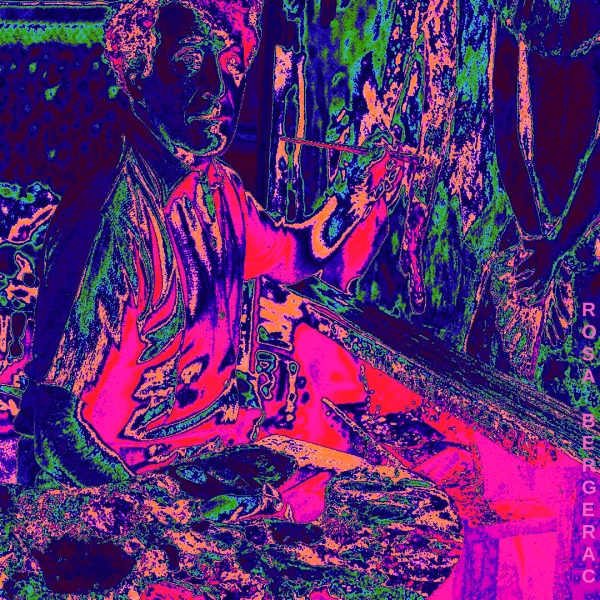
Marc Chagall, as Rosa Bergerac experiences him
“For me a stained glass window is a transparent partition between my heart and the heart of the world” – Marc Chagall
My first Blog post is about Moishe Zakharovich Shagal, better known as Marc Chagall (1887-1985).
Chagall’s artistic journey began in Vitebsk, Belarus, where he was born into a poor Jewish family. His early experiences in a world filled with vibrant culture and folklore significantly influenced his artistic vision. The local Jewish community’s customs and traditions often found their way into his works, reflecting the depth of his cultural heritage.
Chagall’s passion for art was evident from a young age, and he studied in various art schools, including the Zvantseva School of Art in St. Petersburg. It was there that he encountered modern art movements, which would later inform his unique style. His early works were characterized by their use of vibrant colors and emotional depth, which would become hallmarks of his career.
Chagall’s time in Paris was transformative. He became involved with other avant-garde artists, including Pablo Picasso and Amedeo Modigliani, which helped refine his artistic voice. His works from this period exhibit a blend of fantasy and reality, showcasing themes of love, loss, and memory. The influences of Cubism and Fauvism can be seen prominently in pieces such as ‘I and the Village’ (1911), where Chagall integrates elements of his Jewish background with modernist aesthetics.
He was a Russian-born, French-naturalized painter and extremely gifted artist.
Chagall’s contributions to the world of lithography are equally significant. His lithographs often reflect the same themes found in his paintings, such as love, mythology, and personal narratives. The medium allowed him to explore different textures and colors, adding a new dimension to his artistic expression. Collections of his lithographs can be found in various museums, showcasing his versatility as an artist.
Chagall’s unique fusion of art movements can be seen in his stained glass windows. His stained glass works are not just decorative; they are narratives that unfold through color and light. The process of creating stained glass is intricate, involving a deep understanding of light and its effects on color. Each piece is a reflection of his spiritual beliefs and artistic vision, making them profound works of art.
In addition to being found in religious settings, Chagall’s stained glass windows also tell stories from various cultural backgrounds. For instance, the windows at the Hadassah Hospital in Jerusalem depict biblical symbols, while those at the United Nations reflect themes of peace and unity. Each window serves as a dialogue between art and viewer, inviting contemplation and reflection.
The stained glass window in Saint-Stephen Cathedral is often referred to as “Good Lord’s Lantern” for good reason. The intricate design and vibrant colors create an ethereal atmosphere within the church. Visitors often describe the experience of seeing the sunlight streaming through the glass as transformative, illuminating the spiritual space and enhancing the worship experience.
Chagall’s work in Reims Cathedral is equally impressive. The Tree of Jesse window, for example, is a detailed narrative that connects the lineage of Christ to David, illustrating the rich tapestry of biblical history. This window is a testament to Chagall’s ability to merge religious storytelling with artistic expression, captivating viewers with its depth and beauty.
The Hadassah Hospital windows also incorporate elements of Jewish symbolism, resonating deeply with visitors who appreciate their cultural significance. Each panel in the synagogue’s windows is designed to evoke feelings of hope and faith, creating a serene environment for reflection and healing. This connection between art and spirituality is a recurring theme in Chagall’s work.
Most know Marc Chagall from his impressive paintings, which can be found in Musea like, the ‘Guggenheim’, New York, USA, the ‘Philadelphia Museum of Art’, USA, ‘Musee du Louvre’, Paris- France and the ‘Marc Chagall National Museum’, Nice, France.
Chagall’s windows at the Art Institute of Chicago, known as the “America Windows,” reflect his vision of America as a land of freedom and culture. The colorful panels symbolize the immigrant experience and Chagall’s own journey as a refugee during World War II. Each panel is filled with symbolism that invites viewers to explore themes of liberty, hope, and opportunity.
One of the most emotionally powerful works is Chagall’s painting “The Birthday” (1915). This piece is a testament to his deep love for his first wife, Bella Rosenfeld. The vibrant colors and whimsical forms reflect the joy and passion he felt for her. The painting captures the essence of a dream-like celebration, and it is celebrated for its emotional depth. Seeing this piece at the Museum of Modern Art in New York is a must, as it represents a pinnacle of Chagall’s personal and artistic journey.
In addition to his work at the UN, Chagall’s influence extends globally. His stained glass windows can also be found in various countries, including Russia, where they often feature themes of folklore and cultural identity. This international presence reflects Chagall’s status as a beloved artist whose work transcends borders and speaks to universal themes of humanity.
Another notable work, “L’Arbre de Vie,” is a powerful representation of life and spirituality. The tree motif symbolizes growth and connection, resonating with viewers on both personal and collective levels. This piece exemplifies Chagall’s ability to convey complex emotions through simple yet profound imagery that speaks to the heart.
Marc Chagall also made mosaics and quite a number of lithographs, more than 1000.
Chagall’s stained glass windows in Mainz, Germany, are a reflection of his lifelong dedication to the medium. The vibrant colors and intricate designs draw on themes from both his Jewish heritage and universal narratives. These windows serve as a testament to his artistic legacy, inspiring future generations of artists and art lovers alike.
My fascination in Marc Chagall’s work concerns his fusion of fauvism, surrealism and expressionism. His longing to express the deeper meaning of life in his dream like way, sometimes with vibrant colors, flying figures, animals, and biblical themes. My experience is that this shows most magically with Marc Chagall’s Stained glass windows.
The Fraumünster windows in Zurich stand as a remarkable achievement in Chagall’s career. They represent a culmination of his artistic vision, seamlessly integrating modern techniques with traditional stained glass artistry. The collaboration with the glassmaker highlights the importance of craftsmanship in realizing artistic dreams, showcasing how teamwork can bring unique visions to life.
Examples of Marc Chagall’s Stained glass windows can be found in the following locations:
The Marc Chagall National Museum in Nice is a treasure trove of his works. Visitors can immerse themselves in a collection that showcases his evolution as an artist, from early sketches to magnificent stained glass pieces. The museum offers a unique insight into Chagall’s creative process, providing context for his most celebrated artworks.
In the UK, Chagall’s windows can be found in various churches and public buildings, each telling a story that resonates with local communities. These works highlight how art can bridge cultural divides and foster a sense of belonging. Chagall’s ability to connect with diverse audiences is a testament to his enduring legacy as an artist.
Exploring Chagall’s art in person is an experience that lingers in the heart and mind. The interplay of light and color in his stained glass windows creates a breathtaking spectacle that is best appreciated in the context of the spaces they inhabit. Chagall’s work invites viewers to embark on a journey of discovery and reflection, making each visit a worthwhile endeavor.
Chagall’s art goes beyond mere decoration; it serves as a reminder of the beauty that exists in the world and the stories we carry within us. His ability to blend personal narratives with cultural themes makes his work universally relatable. As we admire his creations, we are invited to reflect on our own connections to love, loss, and the human experience.
Marc Chagall, stained glass window, 1962, Saint-Stephen Cathedral, Metz, France, also called “Good Lord’s Lantern” as it has the largest expanse of stained glass in the world.
Marc Chagall was commissioned in 1968 to re-define the medieval interiors of Reims Cathedral, Reims, France, with his Stained glass windows. He completed his works 1974. The far left window focuses on the Old Testament and depicts a motif of Tree of Jesse. The central piece intertwines the lives of Abraham and Christ. The third window describes the story of French monarchy, imagining their coronations.
Hadassah Hospital, Ein Kerem, Jerusalem, Israel – The gorgeous stained glass windows in the synagogue depicting the symbols and devices of the priestly caste of the Israelites, the Tribe of Levi.

In 1970, Chagall made a set of stained glass windows for the Art Institute of Chicago, Chicago, IL, USA. The windows were completed in 1977 and they celebrated the bicentennial of the creation of the States. The 6 panels render America as the country of Freedom and Culture, and this subject made them famous as “America Windows”.

Besides the above location in the US, you can also find Chagall’s stained glass windows at the UN building in New York.
Another commission was Marc Chagall, “L’Arbre de Vie”, 1976, Chapel des Cordeliers, Sarrebourg, France.

Marc Chagall, stained glass window, 1978-1986, St Stephan’s Church, Mainz, Germany. He started this set of windows in 1978 and completed them shortly before death at the age of 97. They are fabulous.

In 1970, Chagall finished the magnificent Fraumunster stained-glass windows.
He worked in close collaboration with a glassmaking factory in Reims. After the colored glass panes were finished, Chagall outlined the figures and elements in black. They were then baked onto the glass. Marc Chagall spent many weeks in Zurich supervising and directing the installation.
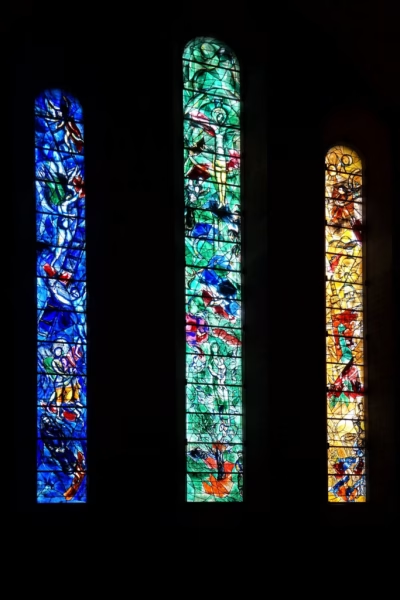
Also the ‘Marc Chagall National Museum’, Nice, France, has some stained glass projects.
Besides France, the USA and Germany, there are also windows from Chagall in the UK.
Please go and have a look, it is really worthwhile. The colors are most alive in the summer when the sun shines through.
Love Rosa Bergerac