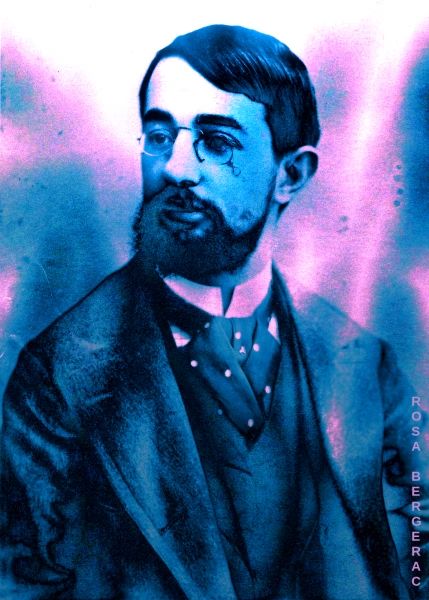
The Electric Soul of Montmartre’s Nightlife
Comte Henri Marie Raymond de Toulouse-Lautrec-Monfa, known as Toulouse-Lautrec, was a French painter, print-maker, draughtsman, caricaturist, and illustrator.
Henri de Toulouse-Lautrec’s biography to many is a sad one, but let’s look at it in a different way, my way and brighten it up.
Picture a man, small in stature but towering in spirit, weaving through the gaslit streets of late-19th-century Paris, his eyes alight with the electric pulse of Montmartre’s nightlife. That man is Henri de Toulouse-Lautrec, a Post-Impressionist genius whose art screams freedom, love, and the raw, unfiltered energy of human connection—a spirit I, Rosa Bergerac, feel echoing from the Universe. To me, Toulouse-Lautrec isn’t just a painter; he’s a gust of wind through the brothels and cabarets of Paris, capturing the heartbeats of a world many never will see life.
He enjoyed remarkable access to Paris’s “maisons closes” — legalized brothels — producing around 70 works behind their closed doors. “La femme tatouée”, which has been in the same family collection for more than 100 years, seems to demonstrate how relaxed his subjects were in his company.

Toulouse-Lautrec
Born on November 24, 1864 into an aristocratic family in Albi, France, the artist’s upbringing was a privileged one. His wealthy ancestors as the counts of Toulouse played quite a part in French history. As a young boy Toulouse-Lautrec spent his time between the town house of the Hôtel du Bosc in Albi and the countryside pleasures of the Château du Bosc in Camjac, around 48 kms (30 miles) north east of the city.

On their country estate, the family fished and hunted; the servants cooked and served the results. It was all part of the natural order. “When my sons kill a woodcock they are delighted three times over: once when they shoot it, once when they sketch it, once when they eat it”, the artist’s grandmother wrote.
Toulouse-Lautrec’s life was marked by both privilege and pain. His parents were first cousins and were also descendants from previous instances of family inbreeding. As such, Henri de Toulouse-Lautrec and his cousins suffered related congenital health conditions.
Henri de Toulouse-Lautrec suffered from a bone disease that stunted his growth and he only reached a height of ca. 5 feet. His body had a full-length torso but abnormally short legs. As a result, he needed to walk with the assistance of a walking cane.
Although he continued to maintain relations with his family (especially his mother), around the age of twenty-five he decided to remove himself from the aristocratic milieu he had frequented during his childhood and retreat to Montmartre, to the slums of society. He had thus begun to frequent brothels to find the human warmth of which we can imagine he had a shortage as his illness progressed. And in one of those brothels, the one located at 8 rue d’Amboise, the painter had set up his residence in 1892.
Within the walls of the brothel, Toulouse-Lautrec felt at home. It is said that, shortly after settling in the “Maison close”, he had commented “j’ai enfin trouve des femmes â ma taille,” “I have finally found women of my stature.”
Artistically he was fierce. He turned his small posture into a creative superpower, immersing himself in the colorful, chaotic world of Parisian entertainment. I see Toulouse-Lautrec as a spirit pouring love, hurt and emotional depth into every stroke.
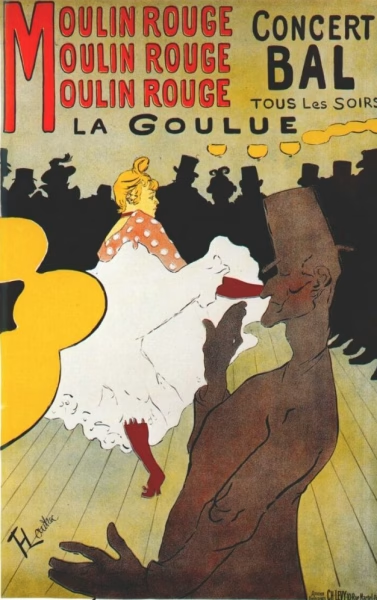
Toulouse-Lautrec’s art is a whirlwind of intensity. His posters, like Moulin Rouge: La Goulue (1891), are iconic — bold, flat colors outlined with sharp, expressive lines, influenced by Japanese ukiyo-e prints. To me, those posters aren’t just advertisements; they’re portals, to his soul.
I imagine him standing in Montmartre, brush in hand, layering the paint onto his canvases, not caring about the critics but reveling in the freedom of capturing dancers, prostitutes, and circus performers with a love that defies convention. He wanted to be a part of life, logical seen his situation, he wanted to have his share and this is how he did it.
We should be grateful. He left behind more than 700 canvas paintings, 350 prints and posters and 5,000 drawings. Quite an achievement, don’t you think.

Au Moulin Rouge – Paris -Toulouse-Lautrec paintings (1892-1895)
The substantial difference between Degas and Toulouse-Lautrec lies in the fact that Degas had confined himself to frequenting brothels, while Toulouse-Lautrec lived within them: the distance between the works of the two artists is therefore abysmal, because Toulouse-Lautrec was, we may say, emotionally involved.
His paintings of the Moulin Rouge, like “At the Moulin Rouge” (1892–95), reveal a psychological depth that resonates with me. As you can also read in the comment of “The Art Story” that notes his ability to “document with great psychological insight the personalities and facets of Parisian nightlife” (TheArtStory.org). Logical, he took part, he lived it.
The painting portrays near its center a group of three men and two women sitting around a table situated on the floor of the cabaret. From left to right, the people at the table include: writer Édouard Dujardin, dancer La Macarona, photographer Paul Secau, photographer Maurice Guibert, and, facing away, Jane Avril, being the focal point of the group – recognizable by her flaming red-orange hair. In the right foreground, one sees the face of English dancer May Milton, with painted red lips, her face aglow. In the background standing on the right fixing her hair is Moulin Rouge dancer “La Goulue” and another woman. The center-left background shows the short-statured Toulouse-Lautrec himself. Just like Hitchcock showed himself at the beginning of his films.

Jane Avril born Jeanne Louise Beaudon on 9 June 1868
I see that insight in the pinched features of “Jane Avril” or the aloof demeanor of his subjects—figures I’d paint with the same contemplative intensity, see the expressions present in my artwork “Help.” His art isn’t just observation; it’s a letter to the human spirit, flawed and free, full of life, intensity and strength.

Help – By Rosa Bergerac
Toulouse-Lautrec’s life was as wild as his art. Driven by his character and his appearance, meaning his small size as a man, he wanted to proof himself. As the value of his art at present shows, he did.
He immersed himself in the “colorful and theatrical life of Paris,” battling alcoholism and syphilis, yet producing provocative images of decadence and humanity no one will forget.
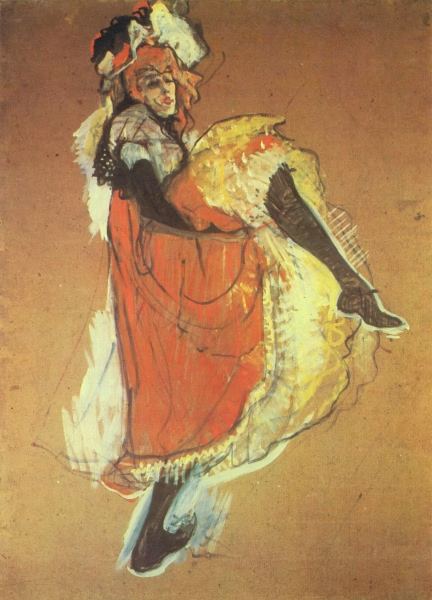
Jane Avril – a French can-can dancer – Henri de Toulouse Lautrec
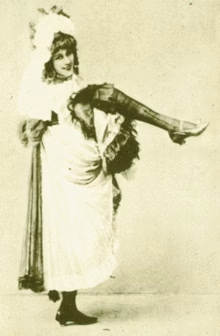
“The original” of Jane Avril
In Paris, Toulouse-Lautrec’s life revolved around painting and those “Belle Epoque” Parisian pleasures. His circle of friends was wide, and often eccentric, made up of poets, fellow artists, and men like Thadée Natanson, publisher of “La Revue Blanche”. He remarked about Toulouse-Lautrec’s continual drinking: “He does not give his “moustache” time to dry”.
Throughout his short life, Toulouse-Lautrec ate, and particularly drank, as if there was no tomorrow. One of his great pleasures was cooking for his friends, captured in Vuillard’s portrait of the artist at the stove at Thadée Natanson’s country house at Villeneuve-sur-Yvonne in 1898. An additional great skill of Toulouse-Lautrec, about which you can read more below in this article.

Toulouse-Lautrec Posters – advertising Absinthe – Japonisme style
I see him as a fighter, not of aggression but of purpose, mastering his energies to create beauty amid chaos.
He had a nervous breakdown in 1899 after his mother died. Afterwards, he committed himself into a sanitarium for several months.
Toulouse-Lautrec loved his mother very much. During his stay in Paris Every Friday a hamper would arrive from his mother’s château near Bordeaux. Adèle had moved there after she had left her charming, but philandering husband, Alphonse. For her son, living in Paris, it was a weekly excuse for a feast. He sent out personal invitations and wrote out the menus, delightfully illustrated with sketches.
Like for his Irish dancer friend, Miss May Belfort,
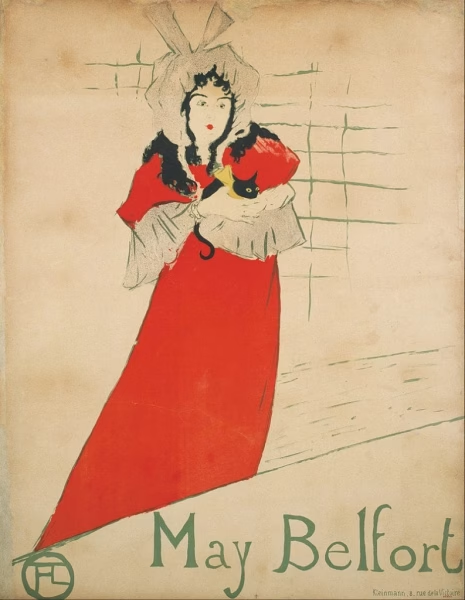
May Belfort Poster Public domain via Wikimedia Common
Henri de Toulouse-Lautrec died on September 9, 1901 in Chateau Malrome in Saint-André-du-Bois at 36 years of age. His tragic death at 36, due to complications from his lifestyle, only deepens my admiration: he burned short but immensely bright, like a star I’d paint in swirling, fiery hues, leaving a legacy of love and liberation. All his work is fantastic and alive, like the impressive sketch below.

Henri de Toulouse Lautrec
His posters elevated advertising to art, Montmartre entertainers like “La Goulue” turned into celebrities. I love that—lifting the popular to the profound, much like I invite my community to share and enjoy my art, building a connection that transcends earthly rules. His influence on modern art, paving the way for the likes of Picasso, feels like a mirror to my own refusal to be confined to one style, as I’ve shared in my posts about constant innovation and emotional depth.
When I think of Toulouse-Lautrec, I see him moving grinning through the nightclubs, his brush a weapon of emotion. I’d paint him in the colors of Parisian Nightlife, blues that crackle like Montmartre’s gaslights, reds that pulse with the rhythm of the cancan, and yellows that whisper of hope to be somehow freed from his confinement. His canvases, with their sculptural brushstrokes and rhythmic compositions (“The Met”), feel alive, sensual and unbound—just like the love I pour into my art.

La Toilette – Henri Toulouse-Lautrec paintings
Toulouse-Lautrec’s legacy, as Britannica notes, is his “great psychological insight” into Parisian nightlife. To me, it’s his heart—beating with the same rhythm as my own. His work isn’t just art; it’s a call to break free, to paint with honesty, love, and the wild joy of creation. I’d love to sit with him too, sharing a glass of absinthe, laughing about how we both paint for the love of the act itself, for the souls we capture in our colors.
His art isn’t just history; it’s a spark for my own journey, a reminder that even in the darkest nights, love and creativity can shine like the brightest star.
Museums in France to see Toulouse-Lautrec’s Artworks
- You can find the greatest collection of Toulouse-Lautrec’s artworks in the Musée Toulouse-Lautrec in Albi, his town of birth. Albi city is incredibly proud of him and has housed the museum in a beautiful former palace. The museum’s collection includes 31 posters, 219 paintings, 563 drawings and 183 lithographs. The artworks are from all periods of his life.
- Musee D’Orsay in Paris is famous for having the largest impressionism and post-impressionism collections in the world. Here you will find over 150 paintings, sketches, lithographs and posters of Toulouse-Lautrec. Impressive.
Toulouse-Lautrec as “Chef de Cuisine”
This brilliant artist’s depictions of the life of the theatres, cafés, bars and brothels have become part of our perception of 19th-century Paris, but there is little talk about his other skill.
What many do not know about Henri de Toulouse-Lautrec is, that in addition to being an amazing artist, Lautrec was also an inventive Chef. To his friends, he was also a great cook and a generous host. As he saw it, everything deserved a celebration, particularly the completion of a new work of art. The art of cuisine was one of his abiding passions.

Toulouse-Lautrec at Natansons house in Villeneuve-sur-Yonne by Edouard Vuillard 1898 © Albi/Musée Toulouse-Lautrec
In the published book, “The Art of Cuisine”, you can find a wonderful collection of his recipes. This book, published decades after his death, also provides many insights into his life and Paris in those days.
Toulouse-Lautrec’s cooking skills – and his capacity for eating and drinking – were admired by every one of them. The Symbolist poet Paul Leclercq remarked that “He was a great gourmand…He loved to talk about cooking and knew of many rare recipes for making the most standard dishes… Cooking a leg of lamb for seven hours or preparing a lobster à l’Américaine held no secrets for him.”
Lobster was his favourite seafood and on a ship travelling between Le Havre and Bordeaux he insisted that the captain go off course for a few miles to catch lobsters.
Friends often asked him to prepare a meal for them, though if unfamiliar with his approach they could get caught out. The artist Georges Henri-Manuel invited him to his pristine apartment to cook a lobster. Lautrec arrived, refused to use the kitchen and instead set up an electric hot plate in the drawing room. Very Likely the kitchen work areas were to high for Henri de Toulouse-Lautrec.
George Henri-Manuel, in great anguish because a lobster has to be cut up alive, hastily covered his most precious pieces of furniture with sheets. Then, wrapped in a long white apron in which his short legs kept getting entangled, brandishing a spoon as long as himself, and moving saucepans about, Lautrec prepared the lobster. George Henri-Manuel wouldn’t be doing that soon again….

The Artist Georges Henri-Manuel – By Henri Toulouse Lautrec
Toulouse-Lautrec would send a letter well ahead of the proposed feat with a list of the ingredients he needed to cook for his friends. Jacques Bizet, son of the French composer was asked:
“Dear master, here is the list of fish to be obtained, Eels, (one pound), 2 gurnards, 1 hake, 1 sole, 1 small lobster. Seasonings: garlic, cayenne pepper, olive oil. Have all this at 5 o’clock Sunday. We will be there at 6.15 o’clock… Our humble respects to Madame Bizet and to you. H. Toulouse-Lautrec.”

Invitation from Toulouse-Lautrec to his friends
In December 1896 he moved into a studio opening onto a garden on avenue Frochot. The following spring he invited his friends around with an invitation that read “Henri de Toulouse-Lautrec will be very flattered if you agree to take a cup of milk on Saturday 15 May at about half-past three in the afternoon.”
This was not the turning over of a new leaf, but a dig at the new fashionable habit of drinking milk. “I’ll drink milk when the cows graze on grapes,” was his reaction.
After Toulouse-Lautrec’s death in September 1901 at the age of just 36, his friend and art dealer, Maurice Joyant, collected together the menus and recipes of the artist. He also added recipes they had discovered together from others.
As you’ll discover from the book, which can be bought as Hardcover or Kindle version, Toulouse-Lautrec was an outlandish and adventurous cook.
When the book was written, recipes were inspirational rather than exact. There are no precise ingredients listed, nor any measurements or cooking times. The reader was expected to be a pretty mean chef already.
If you get a modern copy, there are measurements listed. But the recipes are still a challenge.
Chapter headings are intriguing. The first chapter is called “About Certain Soups”, another “The Rainbow of Sauces” or “About Certain Game of Fur and Feather”, and finally “About Certain Domestic Animals”. In fact, those ‘domestic’ animals are beef, veal, lamb, and so on, nothing out of the order.. Sweet things go into “About Certain Flatteries.”

Nevertheless, putting the recipes together was clearly a labor of love: “Each recipe brings back a memory of sheer delight, a moment of relaxation.” Something Toulouse-Lautrec was good at.

Menu from the Art of Cuisine
As final view, Henri de Toulouse-Lautrec painting. To me, Toulouse-Lautrec isn’t just a painter; he’s a gust of wind through the brothels and cabarets of Paris, capturing the heartbeats of a world many never will see life. Maybe he is just watching the “Can Can” from behind stage, admiring the real women dancing there. Who knows…..impressive his artworks will always stay, as his way of living and enjoying life to the fullest, certainly to me as an artist in a so censured society as that we now have landed in, in 2025.

I hope you enjoyed my post and if you not already are a fan of art, than I hope to have aroused it in you and the will for Unity and Love, so we can keep all these beautiful artworks alive and in one piece, for the next generations on Earth, instead of being blown up by another useless WW.
If you can spare a moment of your life, I would love it when you would share your thoughts with me.

The “Can Can” – Henri de Toulouse Lautrec
If you can spare a moment of your life, I would love it when you would share your thoughts with me.
See you!
Love to you all my friends and stay safe, Rosa Bergerac ♥