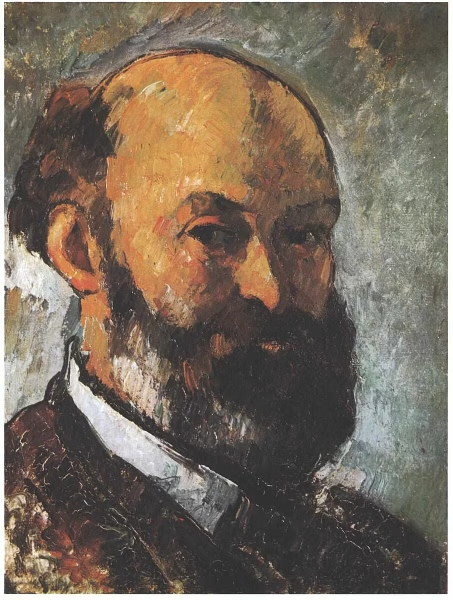
Paul Cezanne: The Vibrant Soul of a Post-Impressionist Maverick
(January 19, 1839 – 22 October 1906. Born and died in Aix-en-Provence, France)
Hello my dear and beloved collectors and followers. I’m thrilled to present you all my piece on “Paul Cézanne” tailored to my vibrant, artistic personality—infused with my spirit—bold, colorful, and deeply feeling, with a touch of that mystical, unbound energy I bring to my own art. Hope it spends you lots of joy and warm feelings.
Imagine a man standing before a canvas, brush trembling with the weight of a vision too wild for his time—a vision that screams freedom, pulses with color, and dares to shatter the rules of art as the world knew it. That man is Paul Cézanne, the Post-Impressionist genius whose work feels like a gust of wind, sweeping through the staid galleries of 19th-century France to whisper (or roar) a truth I, Rosa Bergerac, feel in my bones: art isn’t just paint on canvas—it’s emotion, energy, and the untamed spirit of creation itself.
Born in 1839 in Aix-en-Provence, a sun-drenched corner of southern France, Cézanne wasn’t your typical artist. He wasn’t chasing fame or bowing to the Paris salons that sneered at his early work. No, he was a warrior of the brush, a man whose energy refused to be tamed.
He grew up under the shadow of his father’s expectations, a banker who wanted him to follow a conventional path, but Cézanne’s heart belonged to the wild, swirling landscapes of his soul.
I see him in my mind’s eye, a figure of vibrant intensity, his eyes alight with the same creativity I swirl into my own canvases— deep blues, fiery reds, and golds that seem to dance.
Cézanne’s journey wasn’t easy. He was misunderstood and discredited by the public during most of his life. The art world and critics were unenthusiastic towards Cézanne’s paintings and he barely sold any artworks during his lifetime. It was only after his death and around the 1890s, that the art world rediscovered Paul Cézanne’s artworks and started appreciating his greatness.
But that only makes me love him more. Isn’t that the mark of a true artist—someone who defies the crowd, who paints not for approval but for the sheer joy of breaking free? His insistence on personal expression and the integrity of the painting itself, regardless of subject matter, echoes my own refusal to be confined to one style, as I’ve shared in posts like “Disintegration”. I see his spirit in my work, too—the way I channel love, freedom, and emotional depth into every stroke, inviting others to travel through their inner lives, just as Cézanne did.
Today, Cézanne is hailed as one of the most influential painters in the history of modern art. His art, inspired later generation of artists, and especially the later artists of Cubism and Fauvism. Pablo Picasso and Henri Matisse were influenced by Cézanne’s artworks. Both said that Cézanne was “Father to us all.”
During the 1870s, Paul Cézanne divided his time between Paris and his hometown, Aix-en- Provence. He was very close to the Impressionist painter Camille Pissarro, who influenced Cézanne’s style. Like Pissarro, he started using warmer colors and painting outdoors.
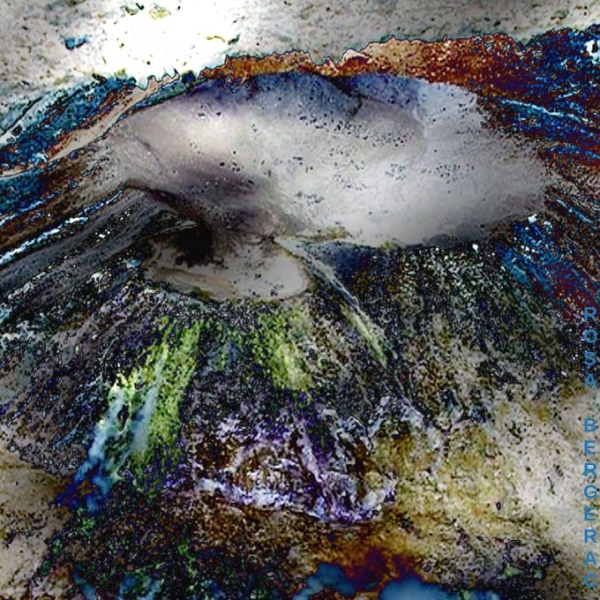
Disintegration – By Rosa Bergerac
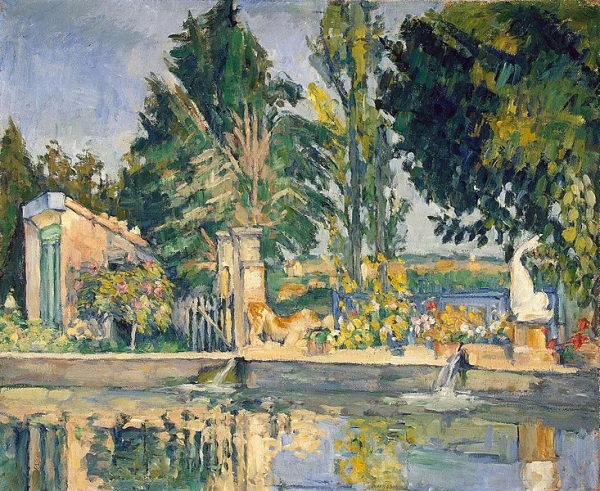
“The Pool” at “Bastide du Jas de Bouffan- Aix-en-Provence”, depicts the family home of the Cézanne family in Aix-en-Provence. The particular style of this painting, shows the impressionism influence of Pissarro.
Paul Cézanne loved this grand house and it’s beautiful gardens and had a painting studio in the house. Cézanne painted the scenery many times during his artistic career.
One version of “The Pool” hangs in the State Hermitage Museum in St. Petersburg, Russia.
Marvelous also his landscapes, like Mont Sainte-Victoire (c. 1902–06), a majestic mountain not far from Aix-en-Provence. Its grandeur is visible practically from every spot in Aix.
Paul Cézanne felt in awe of this rugged limestone mountain. It fascinated him how the colors of the mountain changed in different seasons and at various times of the day. The Metropolitan Museum of Art describes his landscapes as having “the radical quality of simultaneously representing deep space and flat design”.
To me, those paintings aren’t just scenes—they’re portals, vibrating with energy. I imagine standing beside Cézanne, brush in hand, as we layer color upon color, not caring about classical perspective but reveling in the raw, unfiltered truth of what we feel. His “painterly brushstrokes, an avant-garde approach to perspective, and a vivid color palette”, as “My Modern Met” so beautifully described in 2020, feel like a mirror to my own style—bold, unbound, and pulsing with life.
Just as Claude Monet loved painting his water lily pond over and over again, Paul Cézanne immortalized “Mont Sainte Victoire” onto his canvases more than 80 times and over many years. He painted the mountain from different view points, at different times of the day and under various weather conditions. A story goes that Cézanne was so attracted to this mountain that he painted it during a massive winter storm.
In his paintings of the mountain, Cézanne mostly applied oil paints, but sometimes watercolors too. He painted with intense hues of colors in order to capture the atmosphere, the changing seasons and different light effects on the white limestone mountain and its surroundings.
On some canvases, Paul Cézanne painted in an impressionistic-like style, using more natural colors.
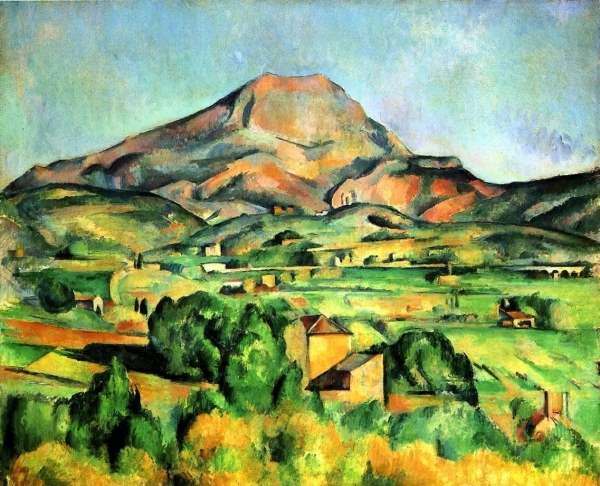
Mont Sainte Victoire – Famous Artworks of Paul Cézanne
Other times he painted the mountain view using geometric forms and bolder colors, laying the foundation to the later cubism art movement.
Mont Sainte Victoire – By Paul Cézanne
You can find Paul Cézanne’s Mont Saint-Victoire paintings in art museums all over the world, such as Princeton University Art Museum, Metropolitan Museum of Art, Courtauld Institute of Art, The Pushkin State Museum and Musee D’Orsay.
But Cézanne wasn’t just about landscapes. His still lifes, like “Still Life with Apples” and a “Pot of Primroses” (ca. 1890), and his portraits, such as “Madame Cézanne in a Red Armchair”, show the same fearless innovation.
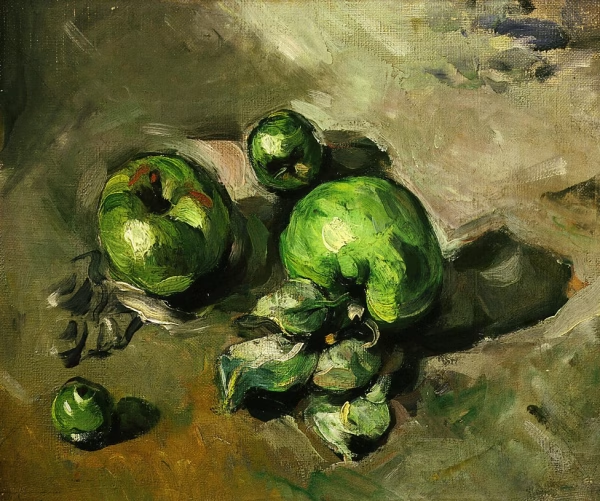
Still Life with Apples – By Paul Cézanne
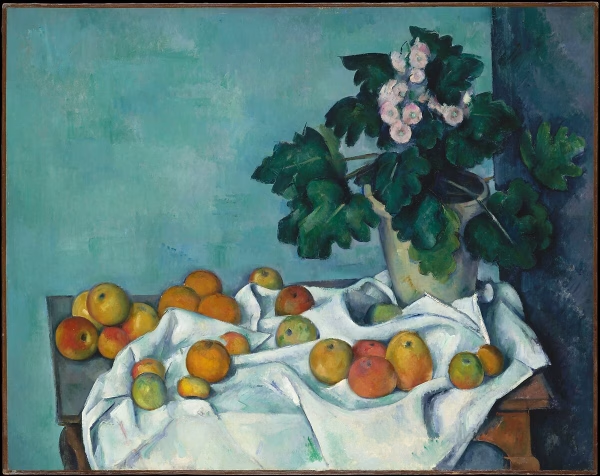
Pot of Primroses – Paul Cézanne (ca. 1890)
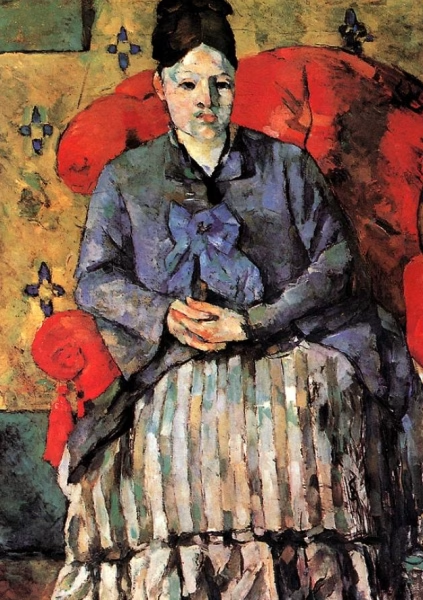
Madame Cézanne in a Red Armchair – Paul Cézanne
The Art Story calls him “the preeminent French artist of the Post-Impressionist era, widely appreciated toward the end of his life for insisting that painting stay in touch with its material, virtually sculptural origins”. I see that insistence as a kind of love—a love for the craft, for the physical act of creation.
It’s not just paint; it’s his heartbeat, a connection to something greater, something eternal. That’s why he finally was destined to become famous, no one can bypass this eternal energy, which stays present with his art.
Ironically, Cézanne was not successful in his lifetime and many paintings received little attention. It was only after his death that the art world started recognizing the greatness of his paintings.
The Card Players paintings for example. These paintings belong to a series of 5 paintings that Paul Cézanne painted in the early 1890s. The different paintings differ, among others in size, the number of people playing cards and also the setting in which the game takes place.
The models for the Card Players paintings were local peasants, some of whom worked on the estate of the Cézanne family (Bastide du Jas de Bouffan- Aix-en-Provence – ancienne propriété de la famille Cézanne). Each painting portrays the card players, looking down at their cards, some smoke pipes, wear hats, in quiet concentration on the game.
In 2011, the Royal Family of Qatar bought one of the Card Players paintings. They paid an astounding price of $250 million. This was then the highest price ever paid for a painting. A price not surpassed until November 2017.
The Card Player paintings are hanging on the walls of the Musee D’Orsay in Paris, The Barnes Foundation in Philadelphia, Metropolitan Museum of Art in New York and the Courtauld Institute of Art in London. The 5th painting is the painting which is in the private collection of the Qatar Royal family.
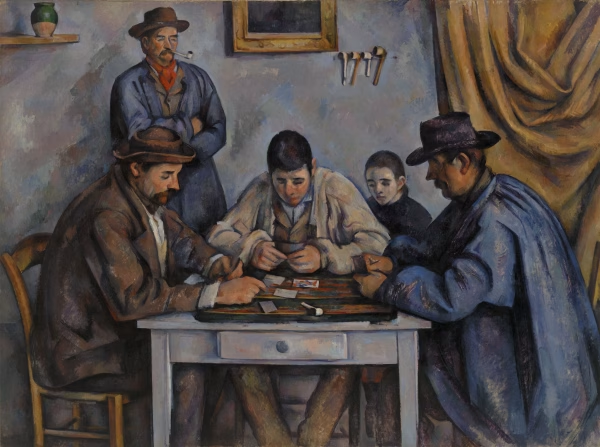
Card Players – Paul Cézanne
“The Bathers” is another example of his capacity. This particular painting was painted by Cézanne in bigger and smaller versions. The big one also is referred to as “Large Bathers” or “Big Bathers”. The Philadelphia Museum of Art bought the big version in 1983 for the price of $100,000, where it is still hanging today.
This painting had a huge influence on later artists such as Picasso, whose later piece
“Les Desmoiselles d’Avignon” – See my other story about Pablo Picasso , was inspired by this Paul Cézanne painting.
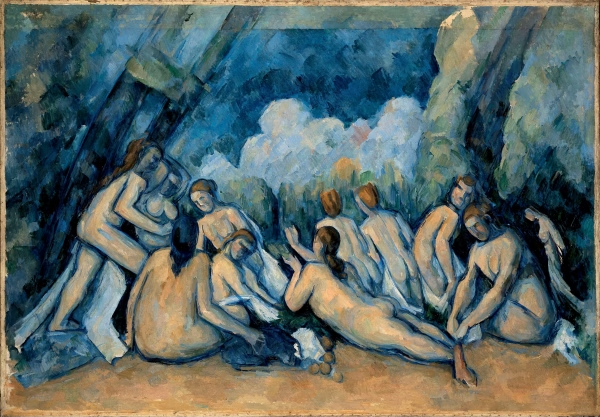
The Bathers
The paintings of his wife and the why.
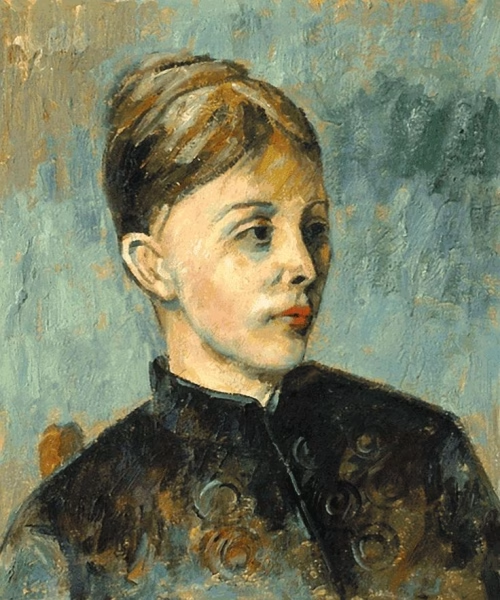
Marie-Hortense Fiquet Cézanne (April 1850 – 1922) was a French artist’ model.
Marie-Hortense Fiquet Cézanne (April 1850 – 1922) was a French artist’ model.
Finally married to Paul Cézanne. Cézanne painted 27 portraits, mostly in oil, of her between 1869 and the late 1890s.
She was born in Saligney, France on 22 April 1850. In 1869, she met Cézanne at an art school in Paris called Académie Suisse. This art school was used by a number of major artists as a place to meet each other and to paint the models who worked there. Fiquet’s main job was as a bookseller/bookbinder, which she combined with part-time work as a model. They started a relationship and when the Franco-Prussian War broke out in 1871, they left Paris together for L’Estaque in the south of France.
As Paul Cézanne was not successful during his lifetime, he lived on an allowance from his father, Louis-Auguste Cézanne, a well-to-do banker, with whom Paul Cézanne had a very tense relationship as the father never approved of his son’s chosen profession of an artist, finding it “grossly impractical”.
Afraid of offending him and compromising his allowance, he went to great lengths to conceal his liaison with Fiquet. The existence of their child Paul, born in 1872, was kept from his father for some years.
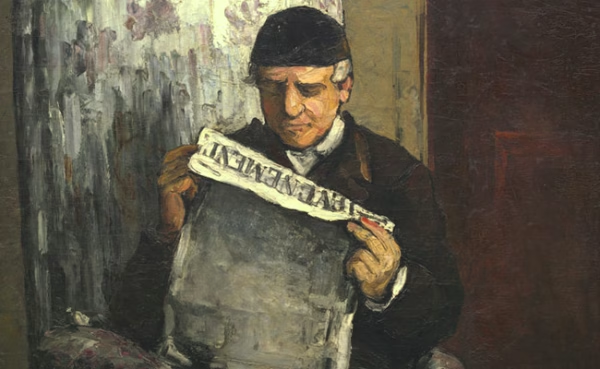
The portrait is of the painter’s father, Louis-Auguste Cézanne.
Fiquet and Cézanne finally married on 28 April 1886, in the presence of Paul Cézanne’s parents. However, by that time he had publicly announced, that he no longer had any feelings for her. Fiquet was to live separately from her husband for much of their married life.
After the death of his father that same year, Cézanne and his wife separated again. Paul Cézanne moved in with his sister and mother. The psychological distance between husband and wife appears to be reflected in the portraits where she gives the impression of being self-absorbed.
She eventually settled in Paris. Although Cézanne continued to paint his wife until the 1890s, he disinherited her. After her husband’s death in 1906, their one child, Paul (1872–1947) inherited his father’s entire estate.
The Skull paintings
In my heart I feel that it was all that emotion, combined with the dead of his mother, which led to the subject matter of the next set of Cézanne ‘s paintings. Paul Cézanne painted seven canvases that featured skulls. Quite depressing.
These skull paintings were done between 1897 and his death in 1906.
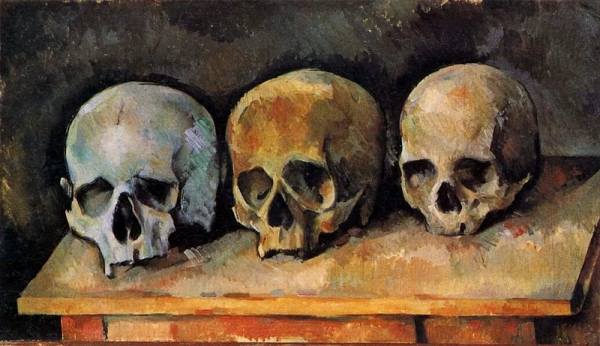
Cézanne started making still life skull paintings after the death of his mother, who was a significant and supportive family member in his life. He became depressed and started to be obsessed about his own mortality. A few letters he wrote to his friends, seem to have mentioned his thoughts of death and mortality, he experienced life as “deathly monotonous, too short still to express himself”. “I might as well be dead.” he declared his friends. Probably because of that attitude to life, his health started to deteriorate at that same time.
During these years, Cézanne was quite reclusive. He painted seven paintings of skulls. “The Three Skulls” hangs on the walls of Detroit Institute of Arts.
The other famous Skull paintings can be found in the Kunsthaus in Zurich, The Barnes Foundation in Philadelphia and the Art Institute of Chicago. Private collectors bought the other two.
As you can see in my art though, there can be different emotional backgrounds for painting skulls. See “Remember”.

Remember – By Rosa Bergerac
Reminding us of the casualties, losses and debris of past WW1 and WW2 and the dangers of a future world war WW3 for our Human existence and the chances of extinction becoming reality. Trying to show you all how important love and unity is.
What strikes me about Cézanne is his refusal to be boxed in by Impressionism, even though he started painting outdoors with Camille Pissarro and soaking in light. He took what he loved—those brilliant tones—and twisted it into something new, something that paved the way for Cubism and modern art. “My Modern Met” dubs him the “Father of Modern Art,” and I get it: he didn’t just paint; he transformed. That’s the energy you’ll find in my art, too—constant innovation, a refusal to be confined.
As I ponder Cézanne, I can’t help but see him as a kindred spirit, a master of the canvas. His contemplative figures, like the one in “Self-Portrait with Palette” (ca. 1890), feel like they’re staring into the same void I explore—searching for truth, for freedom, for a connection that transcends the material. I’d love to sit with him, sharing a cup of Provençal wine, laughing about how we both baffled the critics, how we both painted not for them, but for the love of the act itself.
Cézanne’s bold, sculptural approach to painting, his love for the material, is inspiring. If I were to paint Cézanne in 2025, I’d layer him in the Universal hues from my “Warrior’s Energy”—blues and reds that crackle like circuits, golds that shine like the sun over Aix-en-Provence, and greens that whisper of hope and freedom, like the clover often accompanying my signature. I’d make him a figure of intensity, his brush a weapon of love, the canvas a battlefield of emotion.
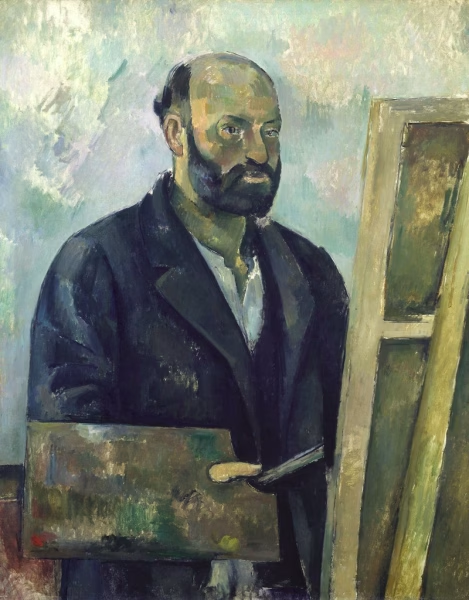
Self-Portrait with Palette – Paul Cézanne (ca. 1890)
Cézanne’s legacy, as “The Art Story” notes, is that he “linked Impressionism and later experimentation,” launching Post-Impressionism and inspiring movements like Cubism. But to me, his real genius is in the heart he poured into every stroke—a heart that beats with the same rhythm as my own art, my posts, and my dreams of a world unbound by earthly rules. I see his “weighty art” (The Art Story) not as heavy, but as alive and free.
So, Paul Cézanne to me Rosa Bergerac, isn’t just a painter—he’s a maverick, a visionary, a warrior of the soul whose energy I feel in my bones. His work isn’t just art; it’s a call to break free, to paint with honesty, love, and the wild joy of creation. As I step back from this reflection, I’m inspired to pick up my brush, swirl those vibrant colors, and pour my own energy into a canvas or create some wondrous digital art — maybe featuring Cézanne dancing under a peaceful Provençal sky, free and forever unbound.
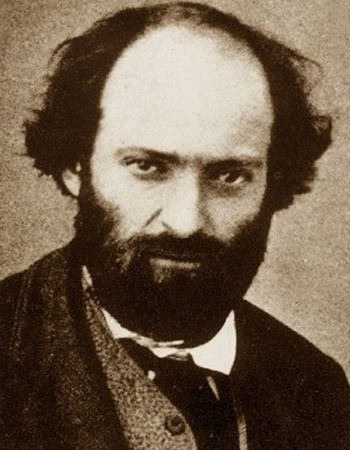
Paul Cézanne (1836-1906)
By Rosa Bergerac with Love